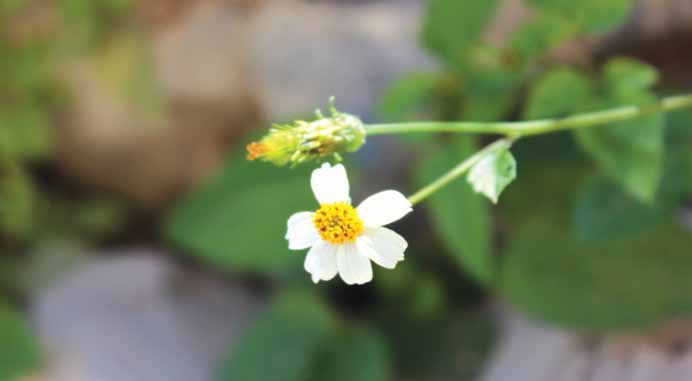
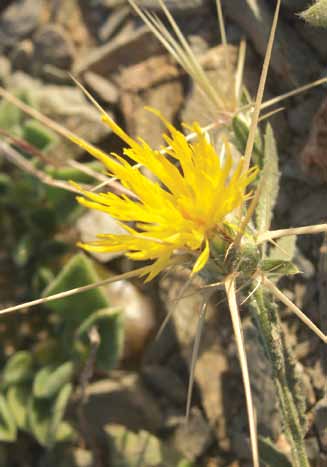
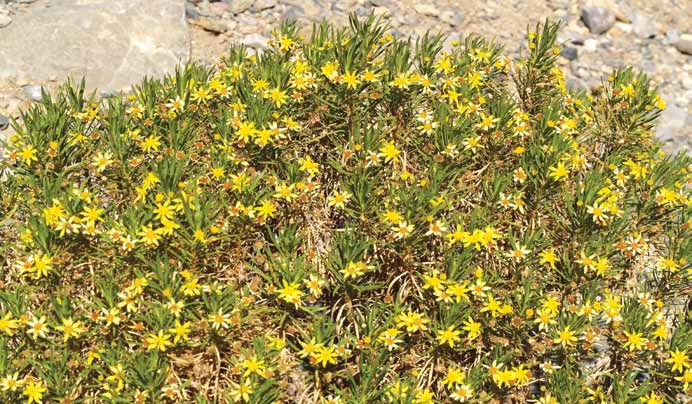
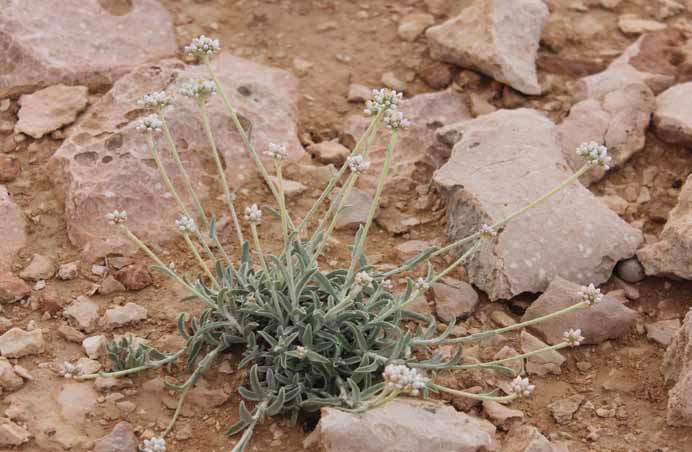
Launaea capitata (Spreng.) Dand.
حوا، حواء، حوذان
For people
- Eaten by people
- Unknown
- Toxic to people
- Unknown
For livestock
- Grazed by livestock
- Good fodder
- Toxic to livestock
- Unknown
Edibility and safety notes
No reliable information on whether people eat this small desert daisy was found; it is not recorded as a food or as poisonous in the sources consulted, so it should not be eaten. The Omani field guide rates it good grazing, and it is common in heavily grazed areas of the Gulf, with no reports of harm to livestock.
This guide is a hobby project, not expert advice. Never eat a wild plant, or feed it to animals, on the strength of this page alone. Read the disclaimer
Description
An annual, procumbent to ascending herb with stems up to 15-40 cm and a few flowering branches in the upper part. Rosette leaves are oblong to spathulate, subentire to sinuate-dentate, with white-cartilaginous denticulate margins.
Habitat
Desert habitats including coastal areas, sandy plains, rocky outcrops, and disturbed or overgrazed areas in subtropical climates.
Distribution
Native from the Canary Islands to Northwest India, including Afghanistan, North Africa (Algeria, Libya, Morocco, Tunisia, Egypt), the Arabian Peninsula (Oman, Saudi Arabia, Gulf States, Yemen), Iran, Iraq, Pakistan, and India.
Pastoral value
Good grazing plant according to the Omani field guide; it persists in disturbed and heavily grazed areas.
Other uses
Used in traditional medicine in some regions. Potential for rehabilitation and restoration of degraded desert ecosystems.
Sources
- الدليل الحقلي المصور للنباتات البرية في سلطنة عُمان (BOOK.pdf p.43)
- Flora of Qatar — Launaea capitata — floraofqatar.com
- GBIF backbone — Launaea capitata (Spreng.) Dandy (name match) — api.gbif.org
- Wikipedia — Launaea (genus, species list) — en.wikipedia.org