
الحبن في وادي سوسه بولاية نزوى
Nerium oleander L.
دفلة، الحبن، حبن
For people
- Eaten by people
- Not edible
- Toxic to people
- Toxic
For livestock
- Grazed by livestock
- Not grazed
- Toxic to livestock
- Toxic
Edibility and safety notes
Deadly poisonous: every part, fresh, dried, boiled or burnt, contains heart-acting glycosides (oleandrin); children have died after eating leaves. Never eat or brew any part, do not use the wood for cooking fires or skewers, avoid the smoke, and wash hands after handling because the sap can irritate skin and eyes. It is as dangerous to animals: about 50 mg of dried leaf per kg body weight is lethal for cattle (goats and sheep somewhat more), 100 g can kill a horse, and smoke from burning cuttings has killed cattle. Animals avoid the bitter living plant but eat wilted clippings or tainted hay.
This guide is a hobby project, not expert advice. Never eat a wild plant, or feed it to animals, on the strength of this page alone. Read the disclaimer
Description
An evergreen shrub or small tree, 2-6 m tall, with thick leathery dark-green lanceolate leaves 5-21 cm long. White, pink, or red five-lobed flowers grow in clusters year-round, peaking in summer. Fruit is a long narrow pair of follicles releasing numerous downy seeds at maturity.
Habitat
Along watercourses, gravelly places, and damp ravines. Tolerant of both drought and inundation but not prolonged frost.
Distribution
Native from the Mediterranean region (Morocco and Portugal) east through western Asia to India, Myanmar and south-west China; in Oman it grows along wadi watercourses in the northern mountains. Widely planted as an ornamental in warm regions.
Pastoral value
Highly toxic to livestock. Ingestion can be fatal to horses, cattle, sheep, goats, and other animals. Must be kept away from grazing areas.
Other uses
Widely cultivated as an ornamental shrub and hedge plant. The sap was historically used as rat poison and the leaves show insecticidal activity. All parts are highly poisonous because of cardiac glycosides such as oleandrin, so the plant is not suitable for any home or folk-medicine use.
Sources
- الدليل الحقلي المصور للنباتات البرية في سلطنة عُمان (BOOK.pdf p.32)
- Wikipedia — Nerium (description, range, toxicity) — en.wikipedia.org
- Ceci et al. 2020, Toxins 12:471 — Outbreak of oleander (Nerium oleander) poisoning in dairy cattle (seen in search results) — dx.doi.org
- Frontiers in Veterinary Science 2025 — cattle deaths after inhaling smoke from burning oleander (seen in search results) — frontiersin.org
- Human Deaths Related to Oleander Poisoning: A Review of the Literature (PMC; seen in search results) — ncbi.nlm.nih.gov
- GBIF occurrences of Nerium oleander in Oman (88 records, incl. Ad Dakhiliyah and Muscat) — api.gbif.org
From the same family
All in this family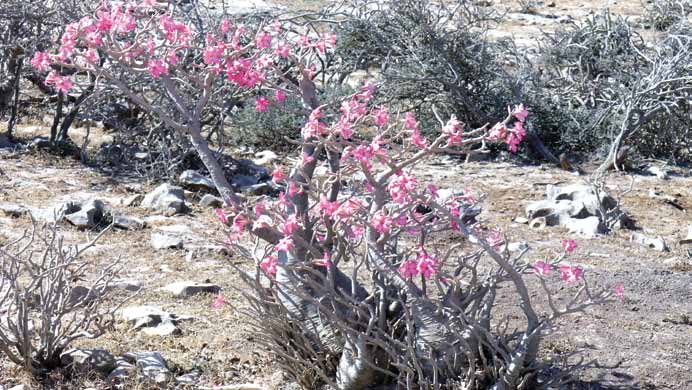
Apocynaceae
Desert rose, Impala lily, Sabi star, Mock azalea
Adenium obesum (Forssk.) Roem. & Schult.
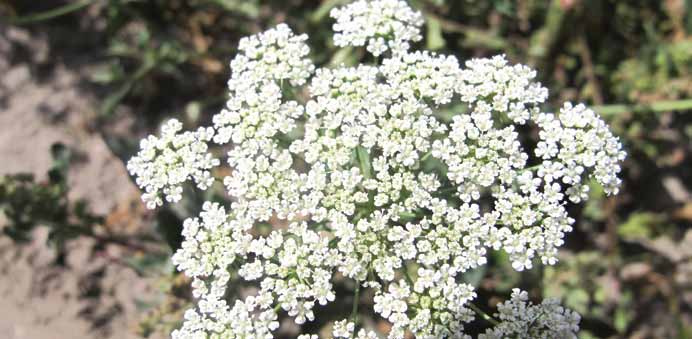
Apiaceae
Bishop's weed, False Queen Anne's lace, Greater ammi, Bishop's flower
Ammi majus L.
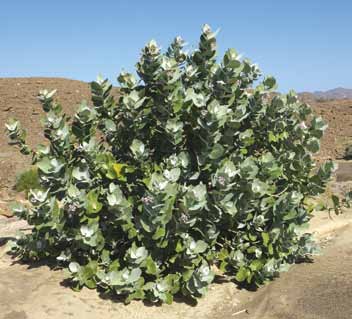
Apocynaceae
Apple of Sodom, Calotrope, Giant milkweed, Sodom apple
Calotropis procera (Aiton) Dryand
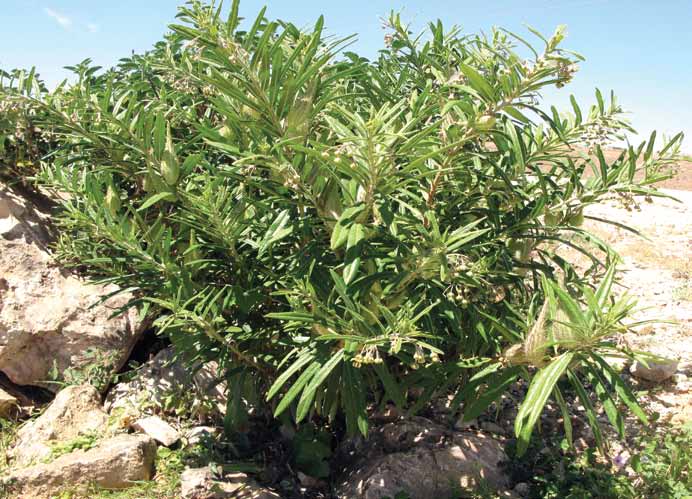
Apocynaceae
Milkweed, Narrow-leaved cotton bush, Balloon cotton bush, Swan plant
Gomphocarpus fruticosus (L.) W.T.Aiton