
Senna italica (Mill.) Lam.
عشرق
For people
- Eaten by people
- Not edible
- Toxic to people
- Toxic
For livestock
- Grazed by livestock
- Limited fodder
- Toxic to livestock
- Unknown
Edibility and safety notes
Not a food plant: leaves and pods contain anthraquinones and are the source of the laxative drug senna; eating them causes diarrhoea, cramps and dehydration, and repeated use is harmful. Only the young green seeds are reported to be eaten as a snack in the African Sahel, not in Arabia. Sheep and goats graze it in eastern Arabia and East Africa, but animals in West Africa avoid it and some Bedouin regard it as harmful to livestock, so its value as fodder is limited and its safety for animals is uncertain.
This guide is a hobby project, not expert advice. Never eat a wild plant, or feed it to animals, on the strength of this page alone. Read the disclaimer
Description
A deciduous perennial herb or small shrub, 50-70 cm tall, with erect, branched stems. Leaves alternate, pinnately compound, with 4-6 pairs of obovate leaflets 2-4 x 1-2 cm, blunt or rounded at the tip and unequal at the base. Flowers yellow, zygomorphic, in axillary or terminal racemes; sepals 5, petals 5 unequal, stamens 10 of which some are sterile; ovary superior. Fruit a flattened, slightly curved pod 3-5 x 1-1.5 cm with several compressed ovoid seeds. Flowers October to March.
Habitat
Grasslands of drier tropical regions, from sea level to 1850 m. Found near streams, in sandy and disturbed habitats, waste places, abandoned gardens, and roadsides.
Distribution
Tropical Africa through Arabia, Iraq, Iran to the Indian subcontinent.
Pastoral value
The Omani field guide lists it as not grazed. Elsewhere reports conflict: in Qatar and East Africa it is grazed by sheep and goats, while in West Africa it is often avoided, and some Bedouin regard it as harmful to livestock.
Other uses
Leaves yield the drug senna (Senna glycoside), widely used as a laxative. In India, used to produce powder for treating hair diseases (neutral henna). Young seeds eaten as snacks or vegetable in Sahel regions.
Sources
- الدليل الحقلي المصور للنباتات البرية في سلطنة عُمان (BOOK.pdf p.119)
- PROTA (Plant Resources of Tropical Africa) - Senna italica — plantuse.plantnet.org(PROTA)
- Wikipedia - Senna italica — en.wikipedia.org
- eNature Qatar - Senna italica — enature.qa
- Flora of Qatar - Senna italica — floraofqatar.com
- POWO - Senna italica Mill. — powo.science.kew.org
- Useful Tropical Plants – Senna italica — tropical.theferns.info
- Comparative metabolite profiling of Senna italica with Senna alexandrina and their hepatotoxicity (Metabolites 2023), abstract via Europe PMC — ebi.ac.uk
From the same family
All in this family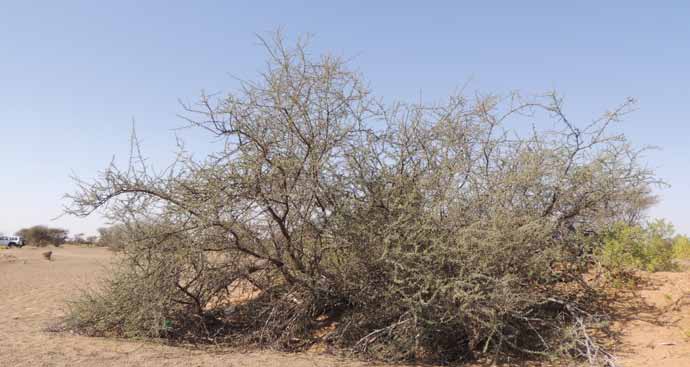
Fabaceae
Salam tree, Desert acacia
Acacia ehrenbergiana Hayne.
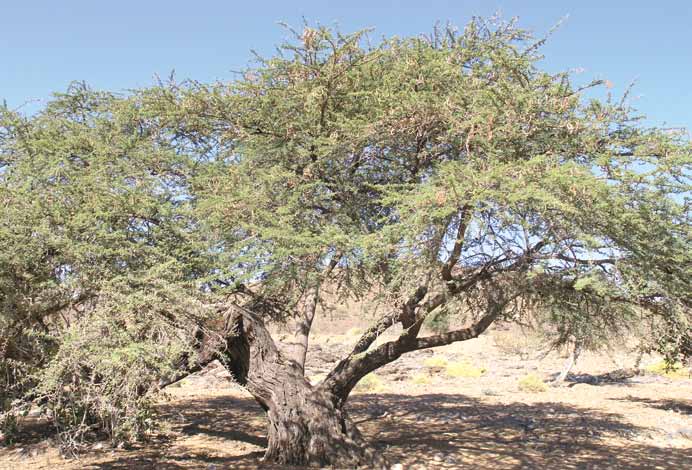
Fabaceae
Red thorn, Grey-haired acacia, Talh
Acacia gerrardii Benth.
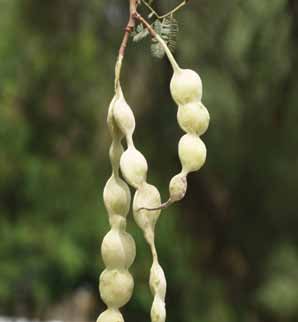
Fabaceae
Gum arabic tree, Babul, Thorn mimosa, Egyptian acacia, Thorny acacia
Acacia nilotica (L.) Del.
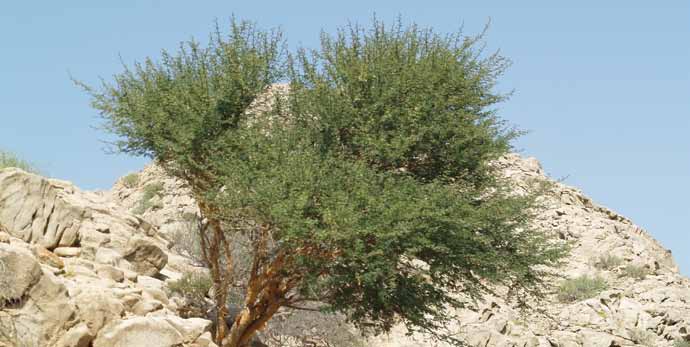
Fabaceae
Gum acacia, Gum arabic tree, Sudan gum
Acacia senegal (L.) Willd.