
Periploca aphylla Decne.
الحندبوب، آرام، اثانثوب
For people
- Eaten by people
- Unknown
- Toxic to people
- Toxic
For livestock
- Grazed by livestock
- Limited fodder
- Toxic to livestock
- Unknown
Edibility and safety notes
Old and regional reports say the sweet flower buds are eaten raw or cooked in north-west India, and that children in Pakistan chew the green fruits and young stems for their sweet sap. These reports are few and no food use is known from Oman. The plant has milky latex, its flowers are used as a strong purgative, and related Periploca species contain heart-active glycosides, so safety is not established and eating it is not advised. The field guide says animals graze it; no livestock poisoning reports were found.
This guide is a hobby project, not expert advice. Never eat a wild plant, or feed it to animals, on the strength of this page alone. Read the disclaimer
Description
A much-branched, erect shrub up to 3 m tall, almost leafless, with milky juice. Branches are long, slender, erect and cylindrical. Small leaves appear only on young shoots in spring and soon fall. Flowers are few, fragrant, in short axillary clusters or umbel-like cymes; the corolla is wheel-shaped, 5-7 mm across, with ovate lobes and a corona of 5 segments. The fruit is a pair of widely divergent, rigid, woody follicles 5-10 cm long. Flowers from February to April (to May).
Habitat
Sandy and stony soils in dry, desert and semi-desert country.
Distribution
Native from Sudan and Sinai through the Arabian Peninsula to northwest India and Pakistan.
Pastoral value
Grazed by animals.
Other uses
Traditionally the latex is applied to swellings and tumours, the flowers are used as a strong purgative and the roots against snake bite; the plant is boiled to protect cotton from rotting.
Sources
- الدليل الحقلي المصور للنباتات البرية في سلطنة عُمان (BOOK.pdf p.33)
- Plants of the World Online - Periploca aphylla Decne. — powo.science.kew.org
- Sturtevant's Edible Plants of the World (1919) - Periploca — henriettes-herb.com
- Wild food plants survey, table 3 (Periploca aphylla 'Barrarr'), J. Ethnobiol. Ethnomed., PMC4826518 — pmc.ncbi.nlm.nih.gov
- Flora of Saudi Arabia checklist - Periploca aphylla (Flora of Pakistan description) — floraofksa.myspecies.info
- Review of the genus Periploca: chemistry, pharmacology and toxicity (RSC Advances 2021) — pubs.rsc.org
- Traditional wild food plants gathered by Ormuri speakers, NW Pakistan (PMC8067455) - latex chewed as gum — pmc.ncbi.nlm.nih.gov
- Review of the genus Periploca: phytochemistry, bioactivities and toxicology (PMC6696197) — pmc.ncbi.nlm.nih.gov
- Antioxidant and antimicrobial activity of Periploca aphylla (PMC3418662) — pmc.ncbi.nlm.nih.gov
From the same family
All in this family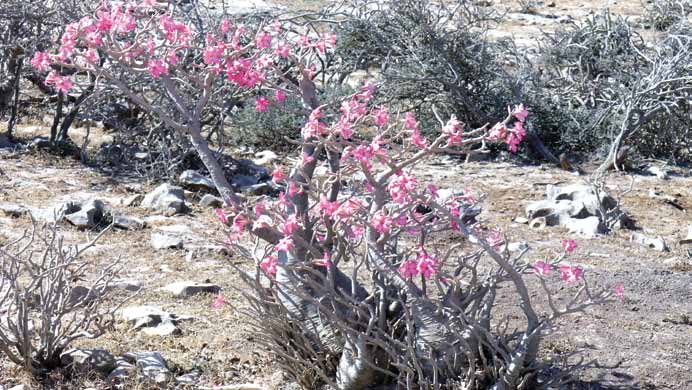
Apocynaceae
Desert rose, Impala lily, Sabi star, Mock azalea
Adenium obesum (Forssk.) Roem. & Schult.
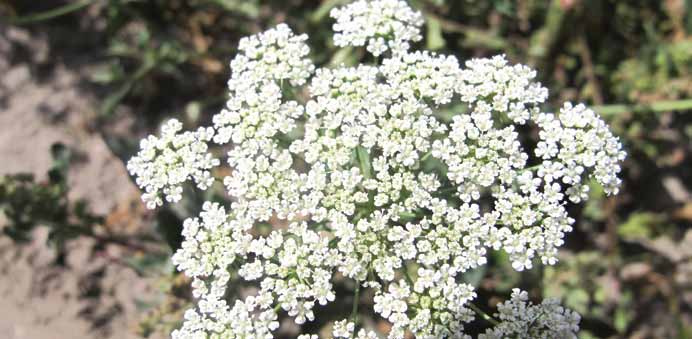
Apiaceae
Bishop's weed, False Queen Anne's lace, Greater ammi, Bishop's flower
Ammi majus L.
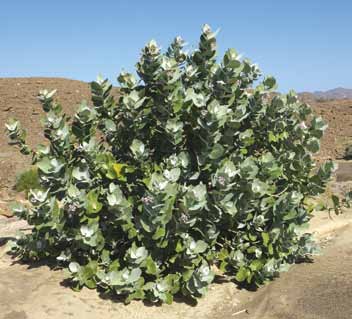
Apocynaceae
Apple of Sodom, Calotrope, Giant milkweed, Sodom apple
Calotropis procera (Aiton) Dryand
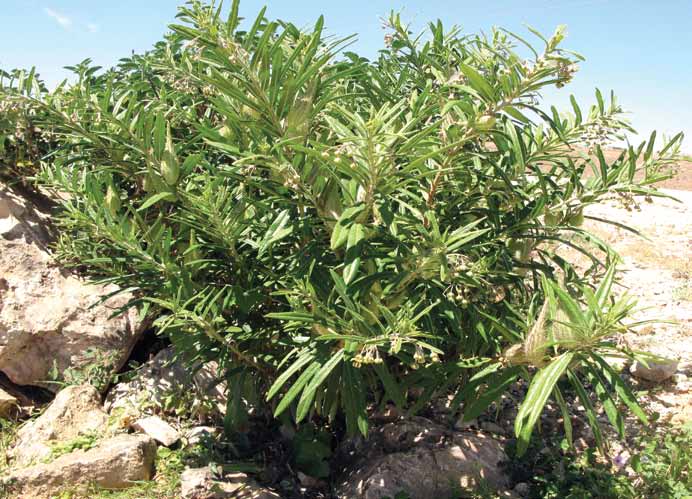
Apocynaceae
Milkweed, Narrow-leaved cotton bush, Balloon cotton bush, Swan plant
Gomphocarpus fruticosus (L.) W.T.Aiton