
Senra incana Cav.
سمرهوت، صمرحت
For people
- Eaten by people
- Unknown
- Toxic to people
- Unknown
For livestock
- Grazed by livestock
- Not grazed
- Toxic to livestock
- Unknown
Edibility and safety notes
No reliable information was found on whether people eat any part of this plant or on its toxicity; it should not be eaten. The Omani field guide records it as not grazed by livestock, and no other grazing or livestock-toxicity data were found. Its only documented use is traditional: an extract of the roots and stems used as a cleaning agent.
This guide is a hobby project, not expert advice. Never eat a wild plant, or feed it to animals, on the strength of this page alone. Read the disclaimer
Description
A perennial herb woody at the base, or a small shrub, up to about 1 m tall, with spreading, hairy branches. Leaves simple, alternate, cordate at the base, shallowly 3- (rarely 5-) lobed with broad triangular rounded lobes, entire, velvety, 1.5-5 x 2-6 cm on petioles 1-6 cm long. Flowers solitary or paired in the leaf axils, about 2 cm across; epicalyx of 3 free cordate segments 2-2.5 cm that become papery and enclose the fruit; calyx 5-lobed, about 5 mm; petals 5, about 8 x 18 mm, pale yellow with a crimson or dark red centre (also reported purple or blue in India); staminal tube bearing many anthers; ovary 5-locular with 2 ovules per cell; stigmas 5. Fruit a globose 5-ribbed, 5-valved capsule 5-6 mm across, enclosed in the enlarged epicalyx. Flowers September to October.
Habitat
Desert and dry shrubland habitats in arid regions.
Distribution
Native to northeastern tropical Africa to eastern Kenya, the Arabian Peninsula, Pakistan to northwestern India.
Pastoral value
Recorded in the Omani field guide as not grazed by livestock.
Other uses
Traditionally used medicinally and as a cleaning agent: an extract of the roots and stems is used as a detergent. Reported to contain the phenolic compounds coniferaldehyde, scopoletin, sinapaldehyde and syringaldehyde.
Sources
- الدليل الحقلي المصور للنباتات البرية في سلطنة عُمان (BOOK.pdf p.139)
- Wikipedia - Senra — en.wikipedia.org
- eFlora of India - Senra incana — efloraofindia.com
- POWO - Senra incana Cav. — powo.science.kew.org
From the same family
All in this family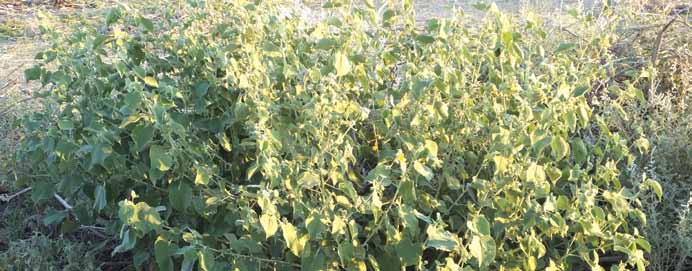
Malvaceae
منكاع، المنقاع، التلمان
Abutilon pannosum (G.Forst.) Schltdl.
Malvaceae
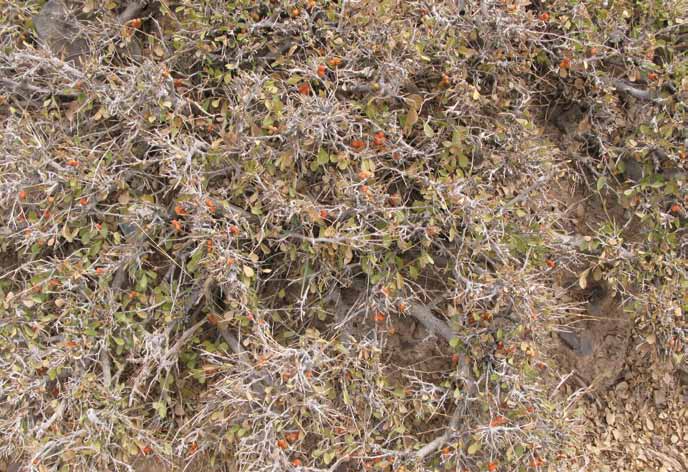
شرحم، ضام، حرطوت، حرشام
Grewia erythraea Schweinf.
Malvaceae
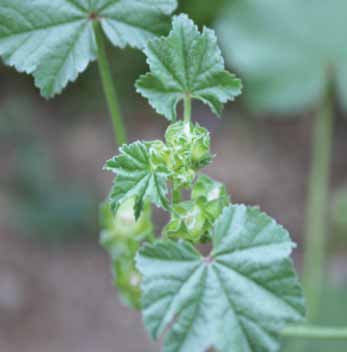
Common Mallow, Dwarf Mallow, Cheeseweed, Buttonweed
Malva neglecta Waller.
Malvaceae
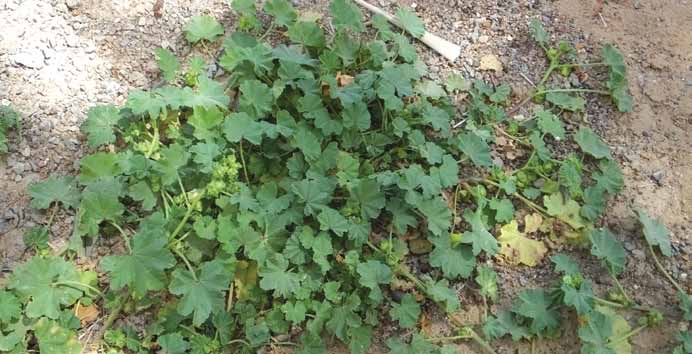
Small-flowered Mallow, Cheeseweed Mallow, Little Mallow, Marshmallow Weed
Malva parviflora L.