
Rhazya stricta Decne.
حرمل، عذفري
For people
- Eaten by people
- Not edible
- Toxic to people
- Toxic
For livestock
- Grazed by livestock
- Not grazed
- Toxic to livestock
- Toxic
Edibility and safety notes
Not a food plant: no part is eaten, and it is described as a poisonous plant rich in indole alkaloids; extracts have shown toxic and genotoxic effects in laboratory studies. It is used only in traditional medicine, and home-made leaf or seed infusions are not safe to try. Livestock avoid it (it is unpalatable and dominates overgrazed land); lambs fed the leaves in an experiment developed weight loss, diarrhoea, laboured breathing and organ damage. The Arabic name 'harmal' is also used for the unrelated toxic plant Peganum harmala.
This guide is a hobby project, not expert advice. Never eat a wild plant, or feed it to animals, on the strength of this page alone. Read the disclaimer
Description
A much-branched, hairless, evergreen dwarf shrub, woody at the base and clothed with old leaf bases, 30–70 cm tall. Leaves simple, short-stalked to almost stalkless, entire, narrowly ovate to lanceolate, leathery, light green, 2–7 cm long and 1–3 cm wide, turning brown and brittle when dry. Flowers in terminal cymes, regular, bisexual, five-parted; the corolla is white with a greenish-yellow tube. The fruit is a pair of erect, cylindrical follicles, green at first and brown when ripe, containing many flattened, brown, narrowly winged seeds. Flowers from February to April.
Habitat
Deserts and dry areas: alluvial and gravel plains, sandy ground and wadi beds. It is characteristic of degraded, heavily grazed rangeland, where it becomes dominant because livestock do not eat it.
Distribution
Arabian Peninsula (Oman, UAE, Qatar, Saudi Arabia, Yemen) and Iraq, extending through southern Iran, Afghanistan and Pakistan to north-western India. In Oman it grows along wadi channels in the north of the country.
Pastoral value
Not a forage plant: it is unpalatable and avoided by livestock, and it is toxic. In an experiment, lambs fed the leaves developed weight loss, diarrhoea, breathing difficulty, hind-limb weakness and organ damage.
Other uses
Traditionally used in Arabian and South Asian folk medicine for fever, rheumatism, diabetes, chest complaints, intestinal worms, dysentery, stomach ache, sore throat, skin complaints and colds (as infusions of the leaves or seeds, or by inhaling the smoke); it has also been used to curdle milk for cheese. The plant is rich in indole alkaloids and is toxic; these are traditional uses, not medical advice.
Sources
- الدليل الحقلي المصور للنباتات البرية في سلطنة عُمان (BOOK.pdf p.35)
- A Review of Rhazya stricta Decne Phytochemistry, Bioactivities, Pharmacological Activities, Toxicity, and Folkloric Medicinal Uses (Plants, 2021) — pmc.ncbi.nlm.nih.gov
- Department of Health Abu Dhabi — Encyclopedia of Medicinal Plants of UAE: Rhazya stricta — medicinalplants.doh.gov.ae
- Wikipedia — Rhazya stricta — en.wikipedia.org
- GBIF species match — Rhazya stricta Decne. — api.gbif.org
- GBIF occurrences in Oman — Rhazya stricta — api.gbif.org
From the same family
All in this family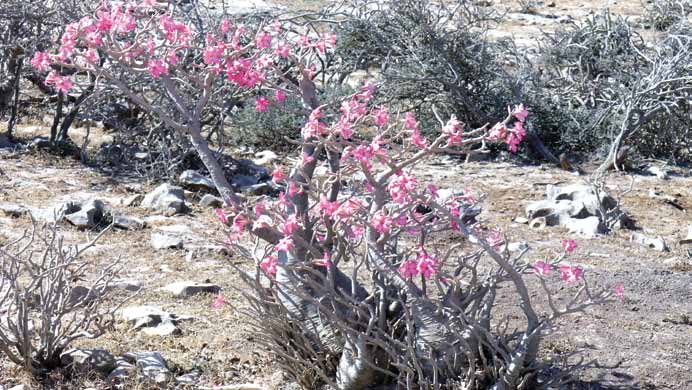
Apocynaceae
Desert rose, Impala lily, Sabi star, Mock azalea
Adenium obesum (Forssk.) Roem. & Schult.
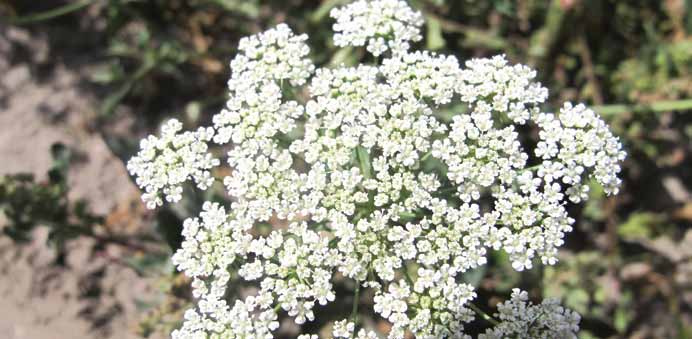
Apiaceae
Bishop's weed, False Queen Anne's lace, Greater ammi, Bishop's flower
Ammi majus L.
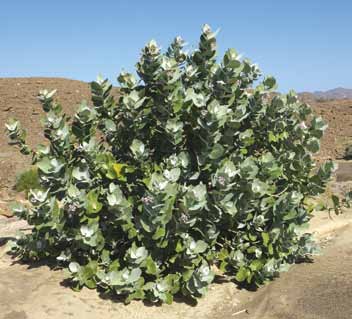
Apocynaceae
Apple of Sodom, Calotrope, Giant milkweed, Sodom apple
Calotropis procera (Aiton) Dryand
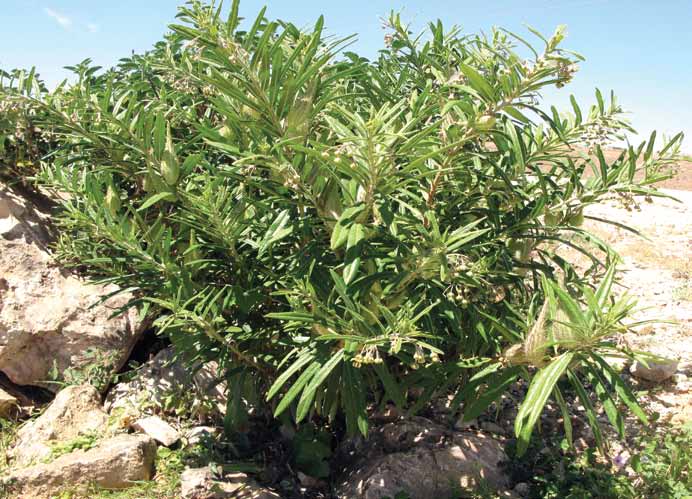
Apocynaceae
Milkweed, Narrow-leaved cotton bush, Balloon cotton bush, Swan plant
Gomphocarpus fruticosus (L.) W.T.Aiton